Jyothis Chandran
PhD candidate · CMB component separation · thermal SZ

I’m a PhD candidate at the Instituto de Física de Cantabria (IFCA, CSIC–UC) in Santander, supervised by Belén Barreiro and Mathieu Remazeilles. I develop component-separation methods that extract faint cosmological signals from multi-frequency CMB data.
Much of my work so far has been on the thermal Sunyaev–Zeldovich (tSZ) effect, the imprint of hot gas in galaxy clusters and the cosmic web. I produced the Planck PR4 NILC Compton-y map (MNRAS 2023). It is public through the Planck Legacy Archive and Zenodo and is used by other groups. I then developed a multi-Stokes Hybrid NILC that uses Planck polarization maps to clean Galactic dust and synchrotron from the essentially unpolarized tSZ signal, combined with selective deprojection of CIB spectral moments (JCAP 2026).
Within the Horizon Europe RadioForegroundsPlus project, I’m now working on two things. The first is non-parametric reconstruction of Galactic free-free emission: I started with NILC and its hybrid and constrained variants, and have moved on to GNILC with deprojection. The second is convolutional neural networks for detecting extragalactic point sources in CMB maps. As a member of the LiteBIRD collaboration’s thermal SZ group, I’m working towards a forecast for the tSZ × ISW cross-correlation. More broadly, I’m interested in secondary anisotropies, spectral distortions, cross-correlations with galaxy surveys, and line intensity mapping.
news
| Nov 2026 | Talk on polarization-informed component separation for thermal SZ Compton-y maps at the XII Meeting on Fundamental Cosmology, Córdoba (slides). |
|---|---|
| Oct 2026 | Contributed talk on Hybrid TQU NILC at Galactic Science and CMB Foregrounds, IAC, Tenerife. |
| Sep 2026 | Talk at Cosmoglobe 2026, Nordita, Stockholm. |
| Aug 2026 | Our paper on polarization-aided foreground cleaning of thermal SZ y-maps is out in JCAP (doi:10.1088/1475-7516/2026/08/062). |
| Aug 2026 | Our PR4 y-map was used to study the hot gas around the Sombrero galaxy (Li et al., ApJ 1009, 72) and in FRB–tSZ cross-correlations (Zhai et al., arXiv:2608.09014). |
selected publications
- JCAP
 Enhanced foreground mitigation in thermal SZ Compton-y maps via polarization and deprojectionJournal of Cosmology and Astroparticle Physics, Aug 2026
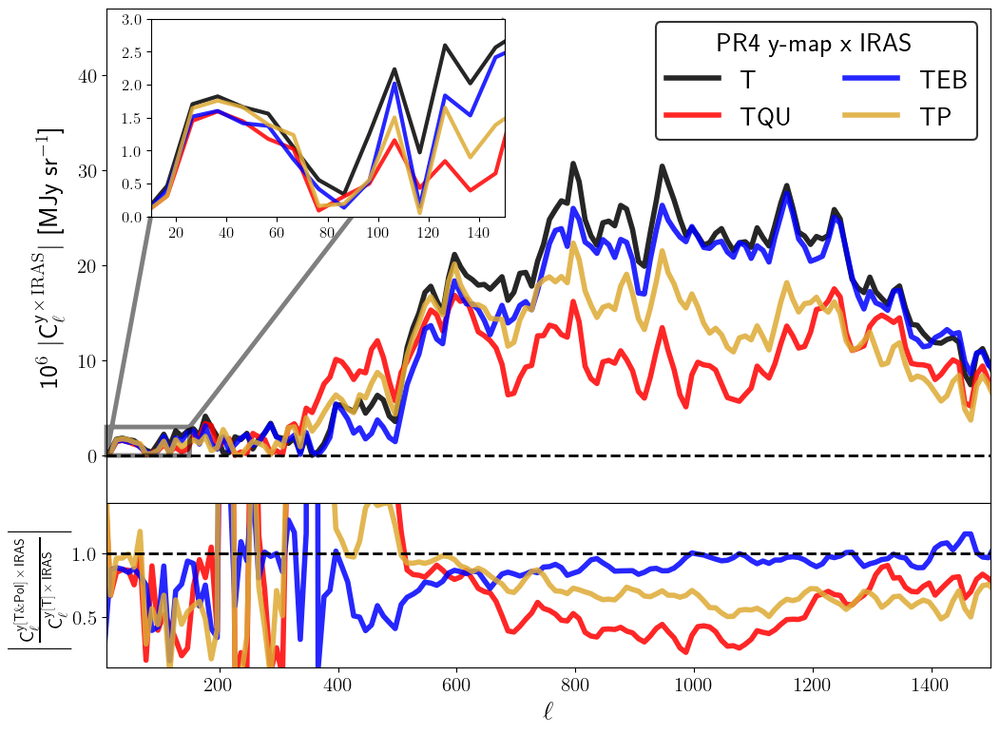
Residual foreground contamination in thermal Sunyaev-Zeldovich (SZ) Compton-y parameter maps (y-maps) arises mainly from Galactic emissions – thermal dust and synchrotron radiation – on large angular scales, and from cosmic infrared background (CIB) anisotropies on small scales. Unlike the thermal SZ effect, Galactic foregrounds are strongly polarized. Exploiting this distinction, we introduce a hybrid Needlet Internal Linear Combination (Hybrid NILC) method that combines Planck total-intensity and polarization frequency maps in the component-separation pipeline, thereby improving the suppression of residual Galactic emission while preserving the unpolarized SZ signal by leveraging the intrinsic TE and TB correlations of thermal dust and synchrotron. Using Planck PR4 data, we find that the Hybrid NILC y-map exhibits about 40% lower cross-correlation with the IRAS dust tracer than the standard temperature-only Planck y-map, indicating reduced residual Galactic contamination. Simulations further indicate that, for future high-sensitivity surveys such as LiteBIRD, the Hybrid NILC will become increasingly effective at suppressing Galactic residuals. We further address small-scale extragalactic contamination by selectively deprojecting specific moments of the CIB using a Constrained Hybrid NILC variant, achieving an improved balance between CIB suppression and noise penalty compared to previous implementations in the literature. These novel approaches – particularly the joint use of temperature and polarization in component separation – offer a powerful framework for disentangling polarized and unpolarized signals.
Show more - MNRAS
 An improved Compton parameter map of thermal Sunyaev-Zeldovich effect from Planck PR4 dataMNRAS, Dec 2023
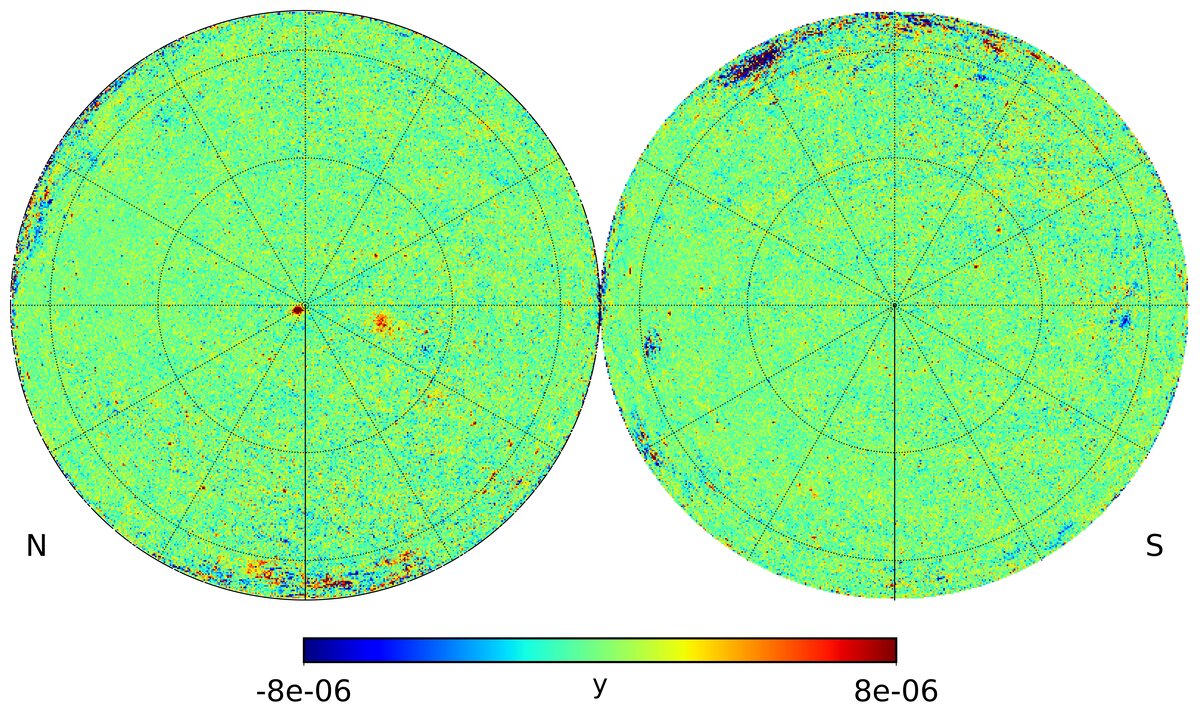
Taking advantage of the reduced levels of noise and systematics in the data of the latest Planck release (PR4, also known as NPIPE), we construct a new all-sky Compton-y parameter map (hereafter, y-map) of the thermal Sunyaev-Zeldovich (SZ) effect from the Planck PR4 data. A tailored Needlet Internal Linear Combination (NILC) pipeline, first validated on detailed sky simulations, is applied to the nine single-frequency Planck PR4 sky maps, ranging from 30 to 857 GHz, to produce the PR4 y-map over 98% of the sky. Using map comparisons, angular power spectra and one-point statistics we show that the PR4 NILC y-map is of improved quality compared to that of the previous PR2 release. The new y-map shows reduced levels of large-scale striations associated with 1/f noise in the scan direction. Regions near the Galactic plane also show lower residual contamination by Galactic thermal dust emission. At small angular scales, the residual contamination by thermal noise and cosmic infrared background (CIB) emission is found to be reduced by around 7% and 34%, respectively, in the PR4 y-map. The PR4 NILC y-map is made publicly available for astrophysical and cosmological analyses of the thermal SZ effect.
Show more